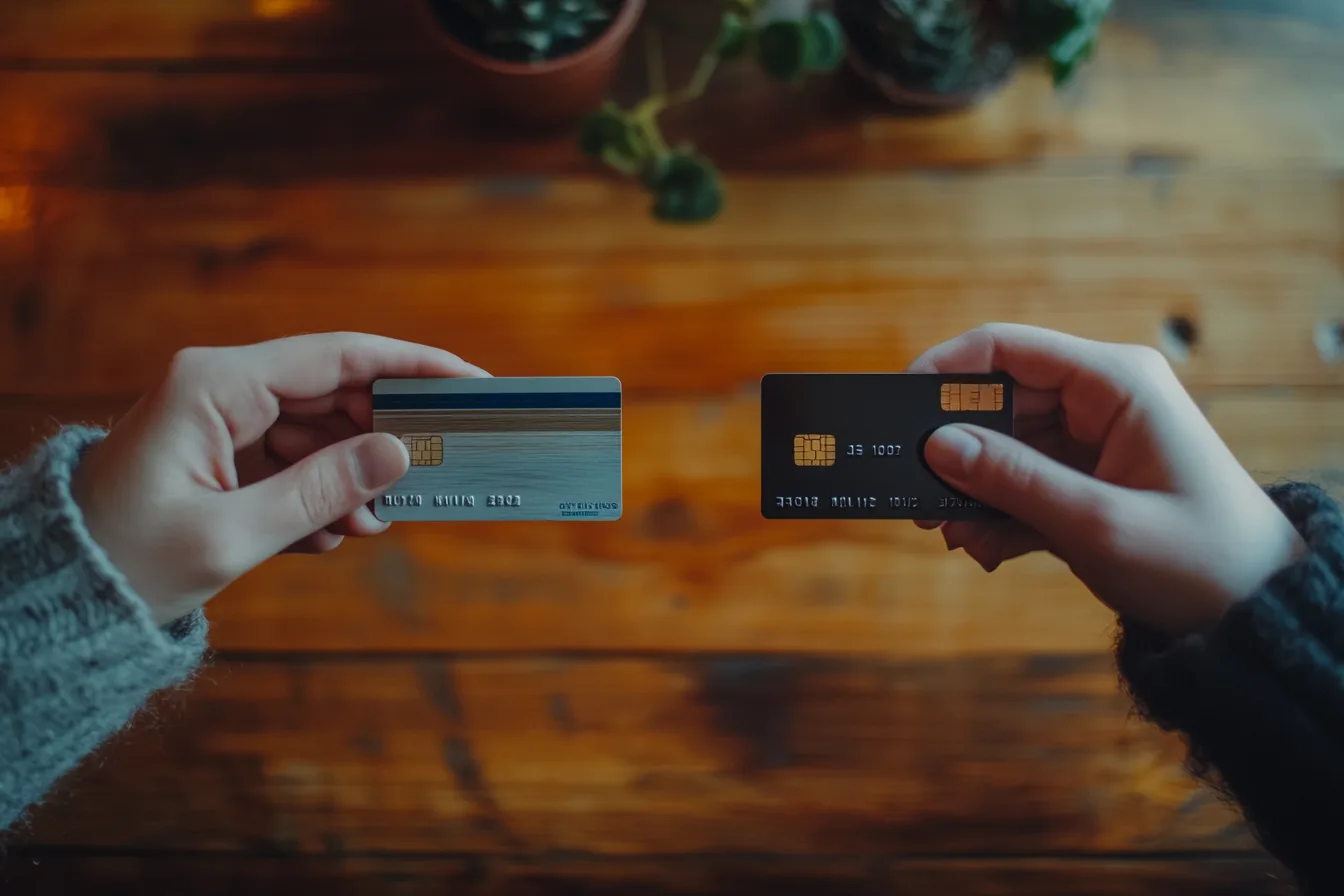
Both personal loans and credit cards provide access to borrowed money, but they function in fundamentally different ways that affect your total cost, repayment timeline, and financial flexibility. Understanding these differences helps you choose the right tool for each specific situation rather than defaulting to whatever is most convenient.
Structural Differences That Matter
A personal loan provides a lump sum deposited into your account, which you repay in fixed monthly installments over a set term. The interest rate is locked at origination and never changes. Every payment reduces both principal and interest on a predictable schedule, and after the final payment, the debt is completely eliminated.
A credit card provides a revolving credit line that you can draw from repeatedly up to your limit. Minimum payments are calculated as a small percentage of the outstanding balance — typically 1–3% — which means the payoff timeline stretches indefinitely if you pay only the minimum. Interest compounds on unpaid balances, and the rate can change based on market conditions or your payment behavior.
When a Personal Loan Wins
Personal loans are the stronger choice when you know the exact amount you need, want a guaranteed payoff date, and benefit from a fixed monthly payment for budgeting purposes. They excel in these scenarios: consolidating existing credit card debt into a lower-rate fixed payment, covering a specific one-time expense like a medical bill or car repair, and situations where disciplined repayment matters more than flexibility.
The math consistently favors personal loans for amounts above $1,000 when comparing total interest paid. A $3,000 balance at 22% APR on a credit card with minimum payments generates over $4,500 in interest over 14+ years. The same $3,000 on a personal loan at 18% APR for 24 months costs approximately $590 in interest with a guaranteed payoff in two years. The savings are dramatic.
When a Credit Card Wins
Credit cards are better for smaller, recurring expenses where you pay the balance in full each month — effectively using the card as a payment convenience tool rather than a borrowing mechanism. They also win when you can legitimately take advantage of a 0% introductory APR offer and are certain you can pay the full balance before the promotional period expires. Rewards points and purchase protection are additional credit card advantages that personal loans do not offer.
However, the 0% intro APR strategy carries significant risk. If any balance remains when the promotion ends, many issuers charge retroactive interest on the entire original purchase amount at rates exceeding 25%. This makes a promotional credit card substantially more expensive than a personal loan if the payoff plan fails.
The Psychological Factor
Beyond the mathematics, behavioral finance research reveals an important difference: personal loans have a dramatically higher full-payoff rate than credit card debt. The fixed term and structured payments create a clear endpoint that motivates consistent repayment. Credit card minimum payments, by contrast, create a psychological illusion of progress while the balance barely moves.
If you struggle with financial discipline — and most people do in some area — the forced structure of a personal loan may be worth a slightly higher rate simply because it guarantees the debt will be eliminated.
Making the Right Choice
Ask yourself three questions. First, do I know the exact amount I need? If yes, a personal loan's lump-sum structure is more appropriate than an open credit line. Second, can I realistically pay the full balance within a credit card's promotional period? If uncertain, a personal loan eliminates the retroactive interest risk. Third, do I need ongoing access to funds, or is this a one-time expense? Ongoing needs favor a credit card; one-time costs favor a personal loan.
For many borrowers, the answer is using both tools strategically: credit cards for daily expenses paid in full monthly, and personal loans for larger, defined borrowing needs with structured repayment.
See Your Personal Loan Options
Apply in minutes — $500 to $5,000 with fixed rates and terms.
Real-World Comparison: Same Debt, Different Outcomes
To illustrate the practical difference, consider Maria, who needs $2,500 for an unexpected car repair. She has two options: put it on her credit card with a 23% APR or take a personal loan at 16% APR over 18 months.
If Maria uses her credit card and makes only minimum payments (typically 2% of the balance or $25, whichever is greater), it will take her approximately 12 years to pay off the $2,500 balance. During that time, she will pay approximately $3,200 in interest alone — more than the original repair cost. Her total outlay: $5,700.
If Maria takes the personal loan at 16% APR over 18 months, her fixed monthly payment is approximately $155. She pays a total of approximately $330 in interest, and the debt is completely eliminated in exactly 18 months. Her total outlay: $2,830.
The difference is staggering: $2,870 in savings by choosing the personal loan. Even if Maria disciplines herself to pay $155 per month on the credit card instead of the minimum, the higher interest rate still results in approximately $450 in total interest compared to $330 with the personal loan — and the credit card balance remains available for reuse, creating temptation that the personal loan structure eliminates.
Hybrid Strategy: Using Both Tools Wisely
The most financially savvy consumers do not choose exclusively between personal loans and credit cards. Instead, they use each tool for its intended purpose. Credit cards serve best as payment convenience tools for daily transactions that are paid in full each month, earning rewards points without incurring interest. They also provide purchase protection, extended warranties, and fraud liability limits that personal loans do not offer.
Personal loans serve best for defined borrowing needs where you know the amount, want a guaranteed payoff timeline, and benefit from the discipline of fixed payments. They excel at debt consolidation, large one-time expenses, and situations where the structured repayment prevents the revolving debt trap that credit cards enable.
By maintaining this strategic separation — credit cards for daily spending paid monthly, personal loans for defined borrowing needs — you access the benefits of both while avoiding the pitfalls of either. Your credit score benefits from the positive payment history on both account types, and your financial flexibility remains intact for whatever needs arise next.